I was always trying to find a good internet cafe closer to work in Lusaka. In May, I noticed on my way to work that there was a new one with big letters painted on the wall close to the Soweto Spar. It took about a month before I managed to go there. Unfortunately I was told that they didn't have any computers yet but that they would arrive maybe next week. I waited again for about a month before checking it again but the answer was still the same: "Maybe next week.". I meant to go there before leaving Lusaka but in the end I forgot to do it so I don't know whether they have the computers even now.
While I was still in Zambia, writing this blog was very important to me and I kept planning blog texts in my head. However, returning to Finland has admittedly reduced my motivation. Lusaka seems so distant now and it's easy to block the whole thing from my mind even though some friends keep reminding me that I haven't updated the blog. Luckily, I also gained some new motivation by talking with some applicants to the ETVO program. Actually few of them told that they had read my blog, or at least browsed it. Wow, I have readers (who are not my friends or relatives). So, I'm still planning to write about few things and finish the blog properly. Most of the posts are almost ready anyway.
So, coming up next: Victoria Falls, the biggest tourist attraction in Zambia. Maybe next week.
Sunday, 26 September 2010

Monday, 23 August 2010
Back in Finland
Just a very quick update: I'm back in Finland. The return didn't work out quite the way I was hoping for because I brought a nasty flu with me. I can't meet my friends since I don't want to spread the flu and eating all my favorite foods is useless as well because I've lost my taste. So far, the only joy has been doing my laundry with a washing machine. Besides that, I spend my time mostly by sleeping.
This isn't yet the end of this blog. I have some posts that I've been writing for a “while” now and I'll try to finish them as soon as I get better.
This isn't yet the end of this blog. I have some posts that I've been writing for a “while” now and I'll try to finish them as soon as I get better.
Tuesday, 10 August 2010
HIV/AIDS
I was talking with a friend about the best ways to avoid advances from Zambian men (“My husband doesn't want me to give my phone number to other men”). She told that one of the things she used to say was “I'm positive.”. It worked otherwise fine but some men answered “It's ok, so am I.”.
HIV and AIDS are present in Zambia in a way that is unimaginable in Europe, even though being openly HIV positive is still rare. My first encounter with it was when another friend was explaining how her friend's husband was sick and how his CD4 count was very low. CD4 count didn't ring any bells with me, so she had to explain what it actually means.
After this discussion, I realized how little I knew about HIV. It could all be summarized with the sentence: “Use condom!”. I had never wondered why HIV has spread so widely in many African countries but I also quickly realized that it's not just about information. Everybody here knows about HIV because everybody has lost friends and relatives because of AIDS.
According to my favorite source, 2007 Zambia Demographic and Health Survey, 14 % of adults aged between 15-49 are HIV positive. In urban areas the HIV prevalence is 20 % compared to 10 % in rural areas. The highest peak in the data is urban women aged 30-34. Over 40 % of them are HIV positive. (These numbers are not very reliable though, as 20 % of those interviewed refused to give blood samples.)
The same source shows also data on HIV/AIDS knowledge. You can look into it in many ways and decide how you want to portray the situation. A pessimist would say that only 35,9% of Zambians have comprehensive knowledge on HIV/AIDS. Optimist would point out that over 80 % know that also a healthy looking person can have HIV and that almost 90 % know that having sex with only one HIV-negative partner reduces risk of contracting HIV. Among the wealthiest and the most educated ones, the level of knowledge is even higher but HIV-prevalence is also highest among them. Obviously, there is a lot of room to improve the knowledge level but no amount of information will solve the whole problem.
Instead, the biggest problem is in behavior. It's very common for men to have several girlfriends, even if they are married. I could tell you amusing stories of married or engaged men trying to hit on me except that they are not really amusing because that is exactly how HIV spreads here. This behavioral difference makes it more likely for HIV to spread here than in the north. Another factor related to this is that HIV is particularly infectious when the infection is new and cannot even be detected in the test. So when the husband gets it from one of his girlfriends in unproected sex, he will soon also transmit it to his wife (and other girlfriends as well.) This is also how HIV is linked to wealth. The poorest cannot afford to have many girlfriends, since the guy is supposed to pay girl's expenses.
(If you think the reason is only condom usage, just have a look at the data on chlamydia in Finland. Chlamydia spreads a lot easier than HIV and is really widespread in Finland. It is actually quite unlikely to contract HIV during one sexual intercourse, though according to statistics, the probability is higher in low-income countries, such as Zambia.)
Another problem is that people prefer not to know about their status. Very few have actually been tested. Women are more likely to be tested ever since many pregnant women get tested, so that the risk of HIV transmission to the baby can be reduced. The ARV treatment is already quite widespread and the coverage is increasing all the time. This brings also hope for more people getting tested when there is actually something that can be done.
What's there to be done? A glimpse of hope comes from that half of Zambians are under 18 and only few of them are HIV positive. Then again, the pressure for them is high. Who doesn't do stupid things as a teenager? For the adults, the requirements are even higher. How does a wife force her husband to use a condom every time? Getting tested sounds simple but how many of us has ever been tested for HIV? And how many would do it yearly?
Based on your choice of statistics, you can decide whether you are pessimistic or optimistic about the HIV situation in Zambia.
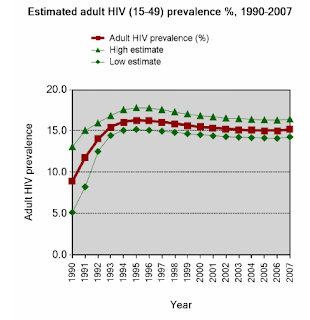
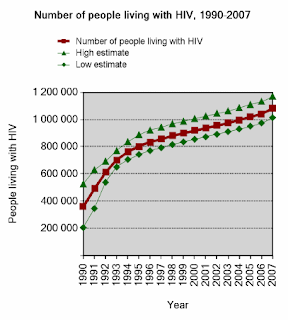
(These pics are from the UN Epidemiological Fact Sheet on HIV and AIDS)
HIV and AIDS are present in Zambia in a way that is unimaginable in Europe, even though being openly HIV positive is still rare. My first encounter with it was when another friend was explaining how her friend's husband was sick and how his CD4 count was very low. CD4 count didn't ring any bells with me, so she had to explain what it actually means.
After this discussion, I realized how little I knew about HIV. It could all be summarized with the sentence: “Use condom!”. I had never wondered why HIV has spread so widely in many African countries but I also quickly realized that it's not just about information. Everybody here knows about HIV because everybody has lost friends and relatives because of AIDS.
According to my favorite source, 2007 Zambia Demographic and Health Survey, 14 % of adults aged between 15-49 are HIV positive. In urban areas the HIV prevalence is 20 % compared to 10 % in rural areas. The highest peak in the data is urban women aged 30-34. Over 40 % of them are HIV positive. (These numbers are not very reliable though, as 20 % of those interviewed refused to give blood samples.)
The same source shows also data on HIV/AIDS knowledge. You can look into it in many ways and decide how you want to portray the situation. A pessimist would say that only 35,9% of Zambians have comprehensive knowledge on HIV/AIDS. Optimist would point out that over 80 % know that also a healthy looking person can have HIV and that almost 90 % know that having sex with only one HIV-negative partner reduces risk of contracting HIV. Among the wealthiest and the most educated ones, the level of knowledge is even higher but HIV-prevalence is also highest among them. Obviously, there is a lot of room to improve the knowledge level but no amount of information will solve the whole problem.
Instead, the biggest problem is in behavior. It's very common for men to have several girlfriends, even if they are married. I could tell you amusing stories of married or engaged men trying to hit on me except that they are not really amusing because that is exactly how HIV spreads here. This behavioral difference makes it more likely for HIV to spread here than in the north. Another factor related to this is that HIV is particularly infectious when the infection is new and cannot even be detected in the test. So when the husband gets it from one of his girlfriends in unproected sex, he will soon also transmit it to his wife (and other girlfriends as well.) This is also how HIV is linked to wealth. The poorest cannot afford to have many girlfriends, since the guy is supposed to pay girl's expenses.
(If you think the reason is only condom usage, just have a look at the data on chlamydia in Finland. Chlamydia spreads a lot easier than HIV and is really widespread in Finland. It is actually quite unlikely to contract HIV during one sexual intercourse, though according to statistics, the probability is higher in low-income countries, such as Zambia.)
Another problem is that people prefer not to know about their status. Very few have actually been tested. Women are more likely to be tested ever since many pregnant women get tested, so that the risk of HIV transmission to the baby can be reduced. The ARV treatment is already quite widespread and the coverage is increasing all the time. This brings also hope for more people getting tested when there is actually something that can be done.
What's there to be done? A glimpse of hope comes from that half of Zambians are under 18 and only few of them are HIV positive. Then again, the pressure for them is high. Who doesn't do stupid things as a teenager? For the adults, the requirements are even higher. How does a wife force her husband to use a condom every time? Getting tested sounds simple but how many of us has ever been tested for HIV? And how many would do it yearly?
Based on your choice of statistics, you can decide whether you are pessimistic or optimistic about the HIV situation in Zambia.


(These pics are from the UN Epidemiological Fact Sheet on HIV and AIDS)
Friday, 6 August 2010
Zambia in numbers
I was in one library in Lusaka some months ago and I happened to see there Zambia Demographic and Health Survey from 2007. Later, to my great surprise, I found the full book from the internet. I was totally fascinated by all this interesting data of Zambia. In case you don't share my enthusiasm and prefer not to read the 500 pages of statistics, I have copied here some interesting bits.
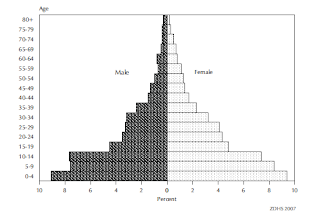
Population pyramid
Number of usual members in the household
Total fertility rate
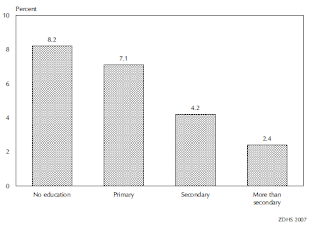
Total fertility rate by level of education
Median age for women to give birth for the first time: 19
Married men: Number of wives
Electricity
Rooms used for sleeping
Place for cooking
Cooking fuel
Household effects
Means of transport
Ownership of bank/savings account
All that data reminds me how privileged I am even with my sort of lower middle-class life here in Lusaka. I have heard some not-very-positive comments on the Central Statistical Office, so maybe all the results are not 100 % reliable, but close enough for simple illustrations like this.
Besides these, the survey includes loads of other interesting data. For instance, 45 % of children are stunted because of malnourishment. Only 11,7 % of adult women had drank milk the previous day, and 5,1% had had cheese or yoghurt. 32,9 % of women and 14,1 % of men find that the husband is justified in hitting or beating his wife when wife burns the food.
The book also describes actions taken to fight malaria. During 2007, 3,5 million insecticide treated nets were distributed. That explains perhaps also why I was expected to be giving away nets, as I mentioned here. (64 % of households have at least one net.)
Population pyramid

Number of usual members in the household
| Urban | Rural | Total | |
| 1 | 6,8 | 8,2 | 7,7 |
| 2 | 11,1 | 9,7 | 10,2 |
| 3 | 13,6 | 14 | 13,9 |
| 4 | 14,9 | 15,6 | 15,4 |
| 5 | 15,3 | 16,2 | 15,9 |
| 6 | 12 | 13,7 | 13,1 |
| 7 | 9,2 | 9,1 | 9,1 |
| 8 | 6,4 | 6 | 6,2 |
| 9+ | 10,7 | 7,4 | 8,5 |
Total fertility rate
| Urban | Rural | Total |
| 4,3 | 7,5 | 6,2 |
Total fertility rate by level of education

Median age for women to give birth for the first time: 19
Married men: Number of wives
| Urban | Rural | Total | |
| 1 | 97,1 | 89,6 | 91,9 |
| 2+ | 2,9 | 10,4 | 8,1 |
Electricity
| Urban | Rural | Total | |
| Yes | 52,1 | 3,3 | 20,7 |
| No | 47,9 | 96,7 | 79,3 |
Rooms used for sleeping
| Urban | Rural | Total | |
| One | 22,3 | 45,3 | 37,1 |
| Two | 38,7 | 37,3 | 37,8 |
| Three or more | 38 | 16,6 | 24,2 |
Place for cooking
| Urban | Rural | Total | |
| In the house | 64,4 | 6,9 | 27,4 |
| Has separate kitchen | 45,4 | 5,4 | 19,6 |
| No separate kitchen | 17,3 | 1,4 | 7 |
| In a separate building | 5,7 | 48 | 32,9 |
| Outdoors | 29,6 | 44 | 38,9 |
Cooking fuel
| Urban | Rural | Total | |
| Electricity | 41,2 | 1,8 | 15,8 |
| Charcoal | 50,7 | 10 | 24,5 |
| Wood | 7,5 | 88,1 | 59,4 |
Household effects
| Urban | Rural | Total | |
| Radio | 75 | 54,7 | 61,9 |
| Television | 63,9 | 8,8 | 28,4 |
| Mobile telephone | 67,9 | 12 | 31,9 |
| Refrigerator | 38,6 | 1,9 | 15 |
| Bed | 92,3 | 57,1 | 69,6 |
| VCR/DVD | 34,4 | 2,1 | 13,6 |
Means of transport
| Urban | Rural | Total | |
| Bicycle | 31,5 | 54,1 | 46 |
| Car/truck | 7,9 | 0,8 | 3,3 |
| Animal drawn cart | 0,8 | 7 | 4,8 |
Ownership of bank/savings account
| Urban | Rural | Total |
| 35,6 | 4,9 | 15,8 |
All that data reminds me how privileged I am even with my sort of lower middle-class life here in Lusaka. I have heard some not-very-positive comments on the Central Statistical Office, so maybe all the results are not 100 % reliable, but close enough for simple illustrations like this.
Besides these, the survey includes loads of other interesting data. For instance, 45 % of children are stunted because of malnourishment. Only 11,7 % of adult women had drank milk the previous day, and 5,1% had had cheese or yoghurt. 32,9 % of women and 14,1 % of men find that the husband is justified in hitting or beating his wife when wife burns the food.
The book also describes actions taken to fight malaria. During 2007, 3,5 million insecticide treated nets were distributed. That explains perhaps also why I was expected to be giving away nets, as I mentioned here. (64 % of households have at least one net.)
Tuesday, 3 August 2010
Crossing borders
During Easter holiday, I went to Malawi. The border crossing there was a bit confusing but painless. I took a direct bus from Lusaka to Lilongwe and the bus didn't need to stop at the border for a very long time. In fact, there was very little queuing, which surprised me.
On the way back, I took a minibus to Mchinji and a share taxi from there to the border. After crossing the border, I was in another share taxi waiting for it to fill up. There was a Zambian man there who had also been in the previous share taxi. I asked from him whether he knew where the two women from that taxi were. He smiled and said: “Oh they, they took the other way.”. I stared at him with my eyes wide open. After that, he explained that they didn't have passports, so they crossed the border somewhere in the bushes.
Later, I learned how difficult and expensive it is to get a passport. Even if you get a passport that is valid for five years, the government might change the passports forcing you to get a new before the old one has expired. And naturally, you need to pay again for the passport.
I was talking about that with a friend and she explained how she hasn't had a valid passport for some years now. That woke up my curiosity because I knew she had been to Tanzania recently. She had also taken the “other way”, and she told that it is really common. After that, I even read a story about it in a newspaper (which I can't find from the internet now).
Some weeks ago, I went to Zimbabwe for a long weekend. I took again a direct bus from Lusaka to Harare. This time, the border controls were tight. Zambian exit controls were together in the same, modern building with the Zimbabwean exit controls. The queues were long and it took almost two hours before the bus could continue. Everyone's passport was checked before re-entering the bus. This time, no-one could take the other route. I don't know is it because the river makes it easier to control the border, or does the other way exist somewhere else. At least, it isn't that simple in the Zimbabwean border.
The long queues in the Zimbabwean border made me realize how big part of the bus passengers must have crossed to Malawi illegally. Nobody seems to think it as a big deal, so the officials have a lot to do if they are planning to stop it.
On the way back, I took a minibus to Mchinji and a share taxi from there to the border. After crossing the border, I was in another share taxi waiting for it to fill up. There was a Zambian man there who had also been in the previous share taxi. I asked from him whether he knew where the two women from that taxi were. He smiled and said: “Oh they, they took the other way.”. I stared at him with my eyes wide open. After that, he explained that they didn't have passports, so they crossed the border somewhere in the bushes.
Later, I learned how difficult and expensive it is to get a passport. Even if you get a passport that is valid for five years, the government might change the passports forcing you to get a new before the old one has expired. And naturally, you need to pay again for the passport.
I was talking about that with a friend and she explained how she hasn't had a valid passport for some years now. That woke up my curiosity because I knew she had been to Tanzania recently. She had also taken the “other way”, and she told that it is really common. After that, I even read a story about it in a newspaper (which I can't find from the internet now).
Some weeks ago, I went to Zimbabwe for a long weekend. I took again a direct bus from Lusaka to Harare. This time, the border controls were tight. Zambian exit controls were together in the same, modern building with the Zimbabwean exit controls. The queues were long and it took almost two hours before the bus could continue. Everyone's passport was checked before re-entering the bus. This time, no-one could take the other route. I don't know is it because the river makes it easier to control the border, or does the other way exist somewhere else. At least, it isn't that simple in the Zimbabwean border.
The long queues in the Zimbabwean border made me realize how big part of the bus passengers must have crossed to Malawi illegally. Nobody seems to think it as a big deal, so the officials have a lot to do if they are planning to stop it.
Monday, 26 July 2010
Some cultural differences
There are many aspects in Zambian culture that I still don't properly understand. One of them is that people are both extremely polite and extremely rude. Nobody wants to tell unpleasant truths, so instead they tell white lies. For instance, there is this guy who often comes to see me at our home (I mentioned how I met him in this blog post. He's starting to annoy me quite a bit but I can't tell that to him because it wouldn't be polite.). He came by several times during the weekend when I was in South Luangwa, and at some point he asked for my number. Obviously, I've instructed my family not to give my number to anyone. In that case, I probably would've told that he should ask the phone number from me when he sees me next time. Instead of that, they claimed that I had changed my number and that they didn't have it – which seems to me like a rather absurd story. Similarly, I've also tried different approaches to declining to give my number and white lies seem to work best. Some guys have simply refused to understand what it means when I say that I don't give my number to strangers.
Then there is the other side of the coin: people are often very rude, at least from a Finnish perspective. A good example of the rudeness was a situation that happened at work. I was supposed to supervise a computer exam for the students. When I went to the computer class, there was a middle-aged man using one of the computers. I told him politely that we are having an exam there and that we need also that computer. He told me that someone had told him that no-one is using the computers at that time and that he was writing some important document for KYP. I tried to be extremely polite and apologized for the misunderstanding but there was no way that he would leave the computer. He told me that he needed it only for a short time, which was in the end 1,5 hours. You might imagine how furious I was because organizing the computer exams is difficult enough even when we can use all the computers. In a situation like this, middle-aged men can be as rude as they want whereas everyone else is expected to accommodate to their needs and be friendly and polite.
(It was also a good lesson for me: even though everything always works out in the end here, it might still be better to plan properly. I'm so used to it now that nothing works as planned that my enthusiasm towards planning has declined and sometimes it has perhaps forced other people to accommodate too much because of my requirements.)
One of the stereotypes about Africa is the communality. It is true, at least here in Zambia. Also that has positive and negative effects from my point of view. It means that basically anyone feels that they have the right to come and talk to me and ask what am I doing here. I understand the curiosity and it's fine with me but it gets a bit tiring sometimes – especially when the discussion turns into my phone number. The positive side is that there are people ready to protect me. When someone has started insulting me, someone else has usually defended me. Or when someone started following me home from the Chawama market, I could just ask some boys to help me and they talked with the guy and I got rid of him.
One of the things that amazed me for a very long time was how nobody seemed to have any money saved for the rainy day. I've since understood that there are actual reasons for that (I know there are probably more of them than the ones that I mention here.). First, the inflation rate in this country is still around 10%, and historically it has been a lot higher. Therefore, it's best to invest the money immediately. Besides that, there are also cultural reasons: If you have money, someone will come to you and ask to borrow it. Because of the requirement to be polite, it is really hard to refuse. And it might be about a sick child or something similar, so you would feel really guilty refusing to lend the money. For the same reason, it is usually possible to borrow money if you really need it. Getting the money back is more difficult, so it's best if you've invested the money so that you cannot lend it to anyone.
So what happens when somebody receives money: Is it all just splurged? A part of it undoubtedly is, and I can understand that. However, a share of it is usually invested. For instance, my family has a fairly big house, that has a small flat separately, where there are tenants. They are also building another small house to the plot. So whenever there is extra money, it is used to buy building materials. That's very common here, and it works as a sort of insurance as well. If everything goes wrong, they can still rely on having they own house and receiving some rent from the tenants.
Then there is the other side of the coin: people are often very rude, at least from a Finnish perspective. A good example of the rudeness was a situation that happened at work. I was supposed to supervise a computer exam for the students. When I went to the computer class, there was a middle-aged man using one of the computers. I told him politely that we are having an exam there and that we need also that computer. He told me that someone had told him that no-one is using the computers at that time and that he was writing some important document for KYP. I tried to be extremely polite and apologized for the misunderstanding but there was no way that he would leave the computer. He told me that he needed it only for a short time, which was in the end 1,5 hours. You might imagine how furious I was because organizing the computer exams is difficult enough even when we can use all the computers. In a situation like this, middle-aged men can be as rude as they want whereas everyone else is expected to accommodate to their needs and be friendly and polite.
(It was also a good lesson for me: even though everything always works out in the end here, it might still be better to plan properly. I'm so used to it now that nothing works as planned that my enthusiasm towards planning has declined and sometimes it has perhaps forced other people to accommodate too much because of my requirements.)
One of the stereotypes about Africa is the communality. It is true, at least here in Zambia. Also that has positive and negative effects from my point of view. It means that basically anyone feels that they have the right to come and talk to me and ask what am I doing here. I understand the curiosity and it's fine with me but it gets a bit tiring sometimes – especially when the discussion turns into my phone number. The positive side is that there are people ready to protect me. When someone has started insulting me, someone else has usually defended me. Or when someone started following me home from the Chawama market, I could just ask some boys to help me and they talked with the guy and I got rid of him.
One of the things that amazed me for a very long time was how nobody seemed to have any money saved for the rainy day. I've since understood that there are actual reasons for that (I know there are probably more of them than the ones that I mention here.). First, the inflation rate in this country is still around 10%, and historically it has been a lot higher. Therefore, it's best to invest the money immediately. Besides that, there are also cultural reasons: If you have money, someone will come to you and ask to borrow it. Because of the requirement to be polite, it is really hard to refuse. And it might be about a sick child or something similar, so you would feel really guilty refusing to lend the money. For the same reason, it is usually possible to borrow money if you really need it. Getting the money back is more difficult, so it's best if you've invested the money so that you cannot lend it to anyone.
So what happens when somebody receives money: Is it all just splurged? A part of it undoubtedly is, and I can understand that. However, a share of it is usually invested. For instance, my family has a fairly big house, that has a small flat separately, where there are tenants. They are also building another small house to the plot. So whenever there is extra money, it is used to buy building materials. That's very common here, and it works as a sort of insurance as well. If everything goes wrong, they can still rely on having they own house and receiving some rent from the tenants.
Friday, 23 July 2010
Cost of living
€ 1 = K 6450 (Damn Greeks!)
Prices:
K 300 SMS
K 500 Tomato
K 500 Banana
K 500 Frita
K 800 Egg
K 1 000 Apple
K 1 000 Orange
K 1 500 Avocado
K 2 000 Cabbage
K 2 500 0,33 l bottle of lemonade
K 3 000 Local newspaper
K 3 000 Minibus ride in Lusaka
K 3 000 0,5 l of milk
K 3 000 0,33 l of coke
K 3 800 Loaf of bread
K 7 500 90 g chocolate bar
K 8 000 Packet of good biscuits
K 8 000 2 yards of chitenge fabric
K 9 000 Hourly rate in an internet cafe
K 9 000 0,5 l of yoghurt
K 10 000 Second-hand dress
K 10 500 Cappuccino
K 12 000 250 g of real butter
K 12 000 6-inch sandwich at Subway
K 13 000 400 g of beef mince
K 20 000 Live chicken
K 26 000 2 l of cooking oil
K 32 500 The Economist
K 35 000 Medium sized pizza
K 35 000 Taxi to Kamwala South
K 35 000 Pair of second hand jeans
K 50 000 Chicken tikka with rice in an Indian restaurant
K 50 000 90 g of parma ham
K 60 000 10 kg of rice
K 60 000 Pair of new jeans (Made in China)
K 60 000 Dorm bed at a backpackers in Lusaka
K 65 000 25 kg of mealie meal (the ingredient of nsima)
K 150 000 Fixed rate water bill for a month (cheaper if there is a meter).
K 150 000 One-way bus ticket to Lilongwe, Malawi
K 150 000 Night in a lodge
K 400 000 Monthly rent for two rooms in Chawama
K 450 000 45 kg bale of second-hand dresses
K 1 200 000 Monthly rent for two rooms in Roma
K 4 000 000 Semester in UNZA without government bursary
K 10 000 000 Monthly rent for a three bedroom house in Kabulonga.
(The prices obviously vary a lot depending on the quality of the goods and where you buy them, so these are just examples.)
Monthly wages are harder to find. The following are according to JCTR but they seem a bit high compared to what I've heard. They get the data from unions and organizations. (They also publish a basic needs basket monthly.)
Guard: 250 000 – 850 000
Secretary: 1 390 500 – 1 900 000
Teacher: 1 300 300 – 2 200 600
Nurse: 1 300 000 – 3 450 000
If you take a good look at the prices, you'll notice that quite a few things are actually more expensive here than in Europe. Dairy products are particularly expensive as are many imported things: computers can cost double the amount they cost elsewhere. I was told that the reason is a monopoly / oligopoly in many products. So while many things are cheap, to have a “western” lifestyle, you need to pay western prices.
A minibus ride for 2000-3000 kwachas doesn't perhaps sound expensive. But if you stop to think of it for a while, it's about K 100 000 in a month. If you need to take two minibuses to get to work, the price doubles as there are no monthly tickets. In practice, you might end up paying more for public transport here than what you'd pay in Helsinki, where you can buy a monthly ticket. Based on means of transport, you can divide people into three income classes: those who walk to work, those who can afford to take a minibus, and those who have their own cars.
When looking at the wages, you might start wondering how do the poorest even manage to pay the rent (I still do). That's why there can be easily ten people living in two rooms. Extended families live together to keep the fixed costs smaller. This is common especially in Lusaka where housing is more expensive than elsewhere in Zambia.
Prices:
K 300 SMS
K 500 Tomato
K 500 Banana
K 500 Frita
K 800 Egg
K 1 000 Apple
K 1 000 Orange
K 1 500 Avocado
K 2 000 Cabbage
K 2 500 0,33 l bottle of lemonade
K 3 000 Local newspaper
K 3 000 Minibus ride in Lusaka
K 3 000 0,5 l of milk
K 3 000 0,33 l of coke
K 3 800 Loaf of bread
K 7 500 90 g chocolate bar
K 8 000 Packet of good biscuits
K 8 000 2 yards of chitenge fabric
K 9 000 Hourly rate in an internet cafe
K 9 000 0,5 l of yoghurt
K 10 000 Second-hand dress
K 10 500 Cappuccino
K 12 000 250 g of real butter
K 12 000 6-inch sandwich at Subway
K 13 000 400 g of beef mince
K 20 000 Live chicken
K 26 000 2 l of cooking oil
K 32 500 The Economist
K 35 000 Medium sized pizza
K 35 000 Taxi to Kamwala South
K 35 000 Pair of second hand jeans
K 50 000 Chicken tikka with rice in an Indian restaurant
K 50 000 90 g of parma ham
K 60 000 10 kg of rice
K 60 000 Pair of new jeans (Made in China)
K 60 000 Dorm bed at a backpackers in Lusaka
K 65 000 25 kg of mealie meal (the ingredient of nsima)
K 150 000 Fixed rate water bill for a month (cheaper if there is a meter).
K 150 000 One-way bus ticket to Lilongwe, Malawi
K 150 000 Night in a lodge
K 400 000 Monthly rent for two rooms in Chawama
K 450 000 45 kg bale of second-hand dresses
K 1 200 000 Monthly rent for two rooms in Roma
K 4 000 000 Semester in UNZA without government bursary
K 10 000 000 Monthly rent for a three bedroom house in Kabulonga.
(The prices obviously vary a lot depending on the quality of the goods and where you buy them, so these are just examples.)
Monthly wages are harder to find. The following are according to JCTR but they seem a bit high compared to what I've heard. They get the data from unions and organizations. (They also publish a basic needs basket monthly.)
Guard: 250 000 – 850 000
Secretary: 1 390 500 – 1 900 000
Teacher: 1 300 300 – 2 200 600
Nurse: 1 300 000 – 3 450 000
If you take a good look at the prices, you'll notice that quite a few things are actually more expensive here than in Europe. Dairy products are particularly expensive as are many imported things: computers can cost double the amount they cost elsewhere. I was told that the reason is a monopoly / oligopoly in many products. So while many things are cheap, to have a “western” lifestyle, you need to pay western prices.
A minibus ride for 2000-3000 kwachas doesn't perhaps sound expensive. But if you stop to think of it for a while, it's about K 100 000 in a month. If you need to take two minibuses to get to work, the price doubles as there are no monthly tickets. In practice, you might end up paying more for public transport here than what you'd pay in Helsinki, where you can buy a monthly ticket. Based on means of transport, you can divide people into three income classes: those who walk to work, those who can afford to take a minibus, and those who have their own cars.
When looking at the wages, you might start wondering how do the poorest even manage to pay the rent (I still do). That's why there can be easily ten people living in two rooms. Extended families live together to keep the fixed costs smaller. This is common especially in Lusaka where housing is more expensive than elsewhere in Zambia.
Subscribe to:
Posts (Atom)